
The EOS survey "European Payment Practices 2025" shows:
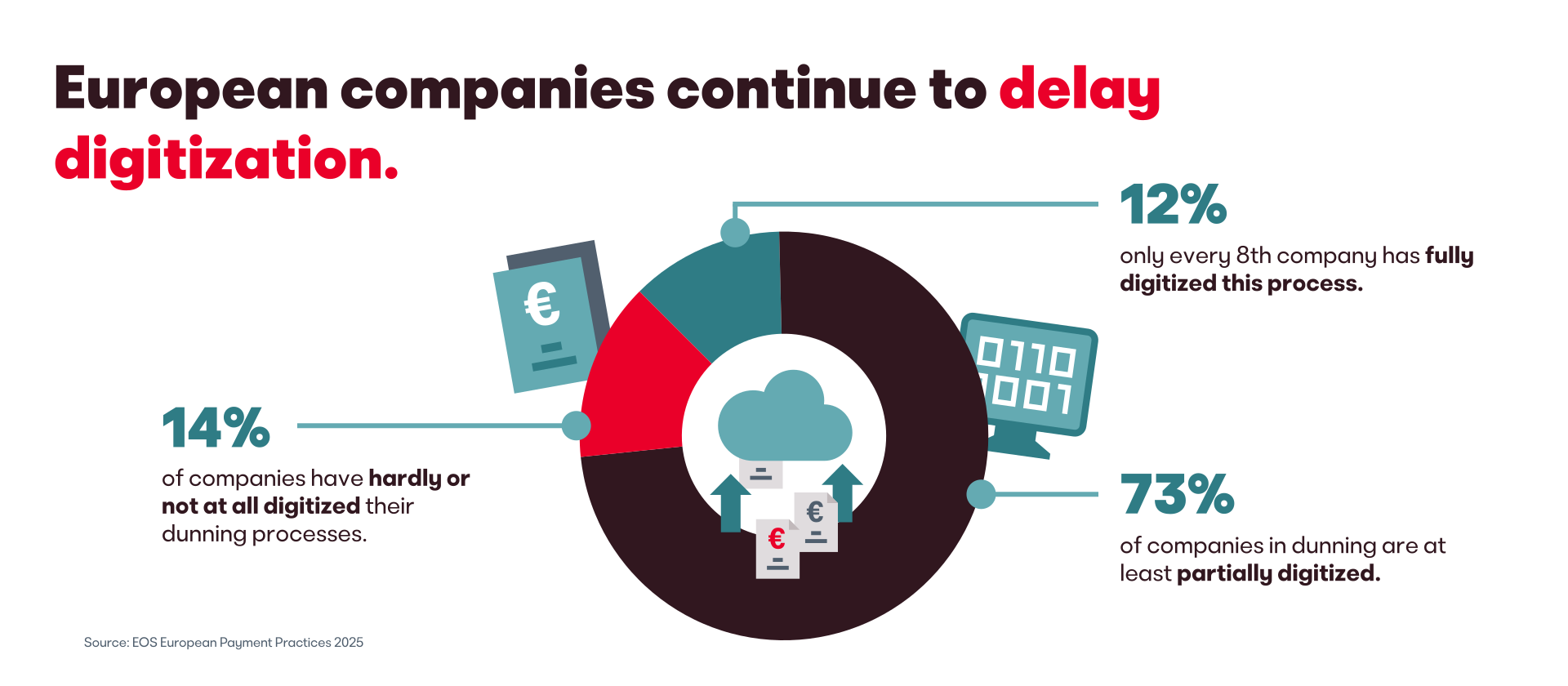
- Only every 8th company has fully digitized receivables management
- Spain, Romania, and Slovenia are pioneers, Germany is lagging behind
- Slow, non-digitized processes are, according to companies, a reason for poor payment practices among business customers
- Intelligent data usage and AI open up new opportunities
With digitized dunning, companies can react faster and more effectively to payment defaults. Nevertheless, only a fraction of European companies currently uses it. Only every 8th European company (12 percent) has fully digitized its dunning process. At least almost three quarters can rely on a partially or even largely digitized dunning process (73 percent) in case of payment default. Three years ago, it was 65 percent*. This is shown by the current EOS survey "European Payment Practices 2025", in which 2,200 financial decision-makers from companies in 11 countries participated.
There is a wide gap between pioneers and laggards in the digitization of dunning in Europe. Spain (65 percent), Romania (64 percent), and Slovenia (64 percent) have the highest degree of digitization. German companies are at the bottom of the European comparison: Here, only 49 percent have largely or fully digitized their dunning processes.

A fully digitized dunning process reduces manual effort and accelerates payments.
Eight percent of European companies still send reminders largely manually, while six percent do not even have a standardized process to pursue outstanding receivables.

Digital dunning processes are an effective solution to poor payment practices.
Currently, a quarter of invoices from European companies are paid late or not at all. Nearly half (48 percent) of financial decision-makers in companies believe that one of the main reasons for poor payment practices among business customers is slow and non-digital processes. 46 percent see one of the reasons for payment delays in staff misconduct, and 44 percent cite formal errors in invoice processing. For private customers, forgetfulness is suspected as one of the main reasons for late payments. Digital processes could provide a remedy here: they facilitate the payment process for customers and ensure transparency regarding payment deadlines. "Overall, digitization creates a smoother payment system and significantly reduces disputes and misunderstandings. On the company side, a fully digitized dunning process reduces manual workload, lowers operating costs, accelerates payments, and allows employees to focus on more complex tasks," notes Paul Baltag, Digital Transformation Manager at EOS in Romania.
Digitized processes increase profitability.
Furthermore, digitization helps in addressing defaulting payers: it automatically selects the communication measure that promises the greatest success. "It becomes exciting when it's not just a mere reminder, but also directly offers a streamlined payment option – for example, via a paylink or open banking functions. This way, it's not just a payment reminder, but a smooth solution for customers," adds Dr. Marcel Mayr, Head of Corporate Development at OTTO Payments, OTTO's payment partner. The online retailer OTTO, like EOS, belongs to the Otto Group.
Artificial intelligence is changing receivables management.
Digitization is the foundation for making data usable on a large scale: "At OTTO, we receive up to 35 orders per second; without smartly automated processes for payment reminders and dunning letters, we wouldn't be able to manage this volume at all," explains Dr. Marcel Mayr. Furthermore, the use of Artificial Intelligence in dunning is becoming increasingly important. "The application possibilities of AI bring 'intelligence' into existing automations, which previously often ran according to simple rule sets. The potential that can be leveraged here in receivables management in the coming years is enormous. In this sense, the AI race significantly increases pressure on those companies that are still in the early stages of digitization."

The application possibilities of AI bring 'intelligence' into existing automations. The potential that will be leveraged here in the coming years is enormous.
About the EOS Study "European Payment Practices 2025"
The survey was conducted with the support of the independent market research institute Kantar between March 27 and May 14, 2025, via online and telephone interviews. A total of 2,200 financial decision-makers from companies in 11 European countries (200 per country) were surveyed.
*Please note: The number of countris surveyed was reduced compared to the EPP 2022 (2025 without SK, GR, DK, BE, and UK). Furthermore, the data collection method was changed from exclusive telephone interviews to a combination of telephone (75 percent) and online interviews (25 percent).

Would you like to learn more about the current EOS study? Please feel free to contact us.

Sabrina Ebeling
Corporate Communications & Marketing
Phone: +49 40 2850-1480
Explore more from EOS